
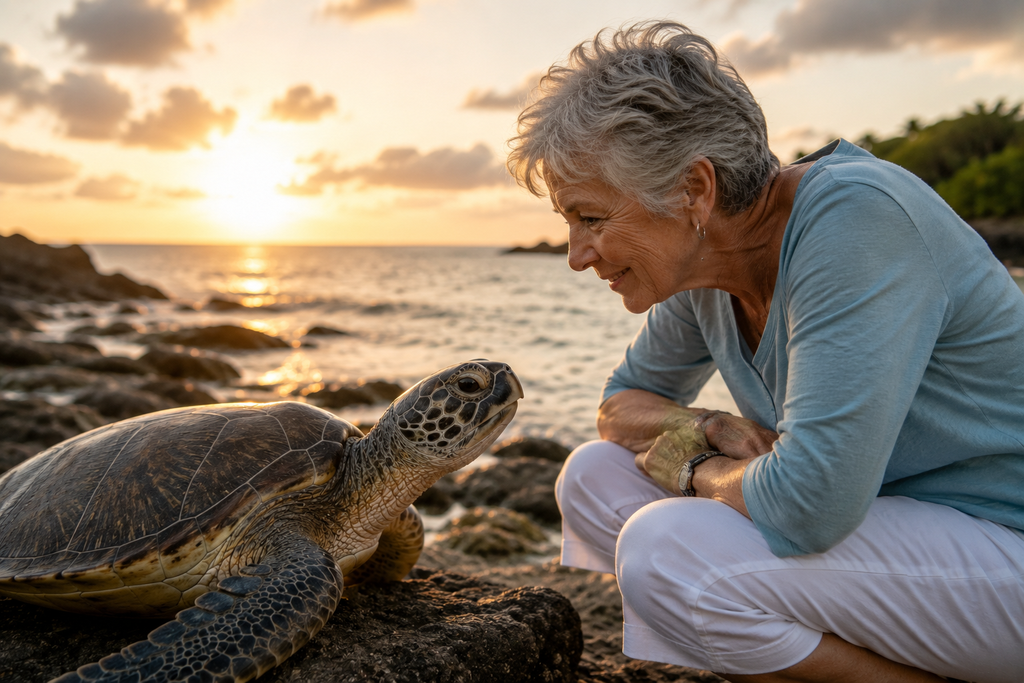
Perhaps one of nature’s oldest travelers has been quietly showing us how to age well all along.
Imagine carrying your home on your back for more than a hundred years. Imagine surviving storms, predators, and a world that never stops changing, not by being the strongest or the fastest, but simply by refusing to stop moving.
That isn’t fiction. It’s a turtle.
For millions of years, turtles have outlasted countless other species. Some live well beyond a century. Jonathan, a Seychelles giant tortoise, is thought to be around 190 years old. They’ve watched the world change again and again, adapting one slow, steady step at a time.
Meanwhile, humans spend much of their lives rushing. We rush through school, into careers, through relationships, toward retirement. Then one day, almost without warning, we wonder where all the time went.
Maybe we’ve been asking the wrong question. Instead of how I move faster, maybe the better question is how do I move better?
The turtle isn’t an obvious teacher, yet few creatures understand longevity as well. Hidden beneath that shell are lessons in patience, resilience, purpose, and what it truly means to grow older.
Lesson One: The Finish Line Keeps Moving
From childhood on, life becomes a series of finish lines: graduate, get the job, buy the house, raise the family, retire. The strange thing is that each finish line quickly becomes a new starting line. We spend decades chasing the next milestone, believing peace is waiting just beyond it.
The turtle seems to know something we forget: there’s no prize for arriving first.
Growing older gives us permission, our younger selves rarely had, to slow down and notice what we’ve been rushing past. A morning cup of coffee. A conversation that doesn’t need to end. Grandchildren discovering the world. Birdsong instead of traffic.
The older we get, the more we realize life’s richest moments are rarely the fastest ones. Slowing down isn’t falling behind. It might be finally arriving.
Lesson Two: We All Carry a Shell
A turtle never leaves home without its shell. It isn’t baggage; it’s protection, history, home.
We carry our own shells, not on our backs but inside us: memories, lessons, heartbreak, people we’ve loved and lost, dreams fulfilled and dreams left unfinished. Some of it makes us wiser. Some of it quietly becomes a weight we’ve carried far too long: old grudges, old fears, old ideas about who we were supposed to become.
One of the unexpected gifts of growing older is realizing we don’t have to carry everything forever. Unlike the turtle, we get to choose what comes with us. Sometimes the lightest life is the one where we’ve finally learned what to set down.
Lesson Three: Living Longer Isn’t the Same as Living Well
Some turtles live astonishingly long lives, but longevity alone isn’t what makes them remarkable. It’s endurance, adaptability, persistence.
We spend enormous energy searching for ways to add years to life: exercise, nutrition, medicine. Those things matter. But a better focus might be: what deserves the time and energy I have left?
A long life means little if we’ve stopped being curious, stopped learning, stopped laughing, and stopped connecting. Growing older isn’t just about adding birthdays. It’s about filling those birthdays with purpose, starting something new, helping someone else, or sitting with someone you love on an ordinary afternoon and realizing it was extraordinary all along.
Lesson Four: Wisdom Can’t Be Downloaded
Need directions? There’s an app. Need information? Search for it. But wisdom has never worked that way. It can’t be streamed or summarized into a thirty-second video. It must be lived, grown slowly through mistakes, second chances, and years of learning that life rarely unfolds as planned.
That’s why older adults often see things differently. They recognize patterns younger people haven’t lived long enough to notice. They know today’s crisis usually isn’t forever, and which problems deserve attention and which don’t. That’s not slower thinking. It’s deeper thinking.
Lesson Five: Even Turtles Know When to Retreat
When danger appears, a turtle doesn’t argue with it or pretend to be fearless. It retreats into its shell until it’s safe to come back out.
Modern life pushes constant availability: answer every message, attend every event, have an opinion about everything. Growing older often teaches the opposite. Protect your peace. Not every invitation deserves a yes. Not every disagreement deserves your energy.
Sometimes strength looks quiet. Sometimes wisdom simply says, “Not today.” Rest isn’t weakness; it’s preparation for whatever comes next.
Lesson Six: Slow Still Moves Forward
The greatest misunderstanding about turtles is thinking that because they’re slow, they aren’t making progress. Yet given enough time, they cross beaches, forests, rivers, and oceans one step at a time.
Growing older often looks the same. Energy changes, priorities change, but growth doesn’t have to stop. Learning new technology. Trying a hobby you’ve always been curious about. Volunteering. Writing down your family’s stories. Starting something small. None of it requires youth. It just requires movement.
Life rarely changes through dramatic leaps. More often, it changes through small, repeated choices. The turtle never apologizes for its pace. Maybe we shouldn’t either.
Lesson Seven: Home Is Something We Carry
A turtle carries its home wherever it goes. We often think of home as a place, but that idea gently changes as we grow older.
Children grow up. Homes are sold. Some people downsize; others move closer to family; some find community in retirement living. Eventually, we realize home isn’t measured in square feet. It’s the smell of a favorite meal, the chair that fits you perfectly, and someone saying they’re glad you came.
Home was never really a building. It’s something we carry inside us.
Maybe We’ve Been Looking at Turtles the Wrong Way
Maybe turtles aren’t slow. Maybe they’re simply intentional. They don’t compare themselves to rabbits, chase every distraction, or rush because others are. They just keep moving toward what matters.
Growing older invites us to do the same: to stop measuring life by speed, to stop comparing ourselves to who we used to be, and to recognize that patience, experience, kindness, rest, and curiosity all still have value.
The years may change our bodies, our routines, even our dreams. But they don’t have to diminish our capacity to keep growing.
That’s what AgeShifts is all about. Growing older isn’t about becoming less; it’s about becoming different. Finding new ways to stay independent. Discovering tools that make life easier. Learning about benefits and resources that open new possibilities. Supporting the people we love. Continuing to ask questions, adapt, and find joy in unexpected places.
The turtle has spent millions of years proving that life isn’t defined by speed. It’s defined by perseverance.
Keep moving. Keep learning. Keep adapting. Keep living one steady step at a time.